


1. Its History – Michael Byrne
The catholic church now in use at Durrow dates back to 1831. Earlier churches in use were, first of all, that at the old abbey until the Reformation in the 1540s, when it became the property of the established Church of Ireland. It was not to be used for catholic services again until 1690 when catholics expecting James II to restore the churches to them proceeded in many places including Durrow and Lynally to repossess the old buildings. In a letter dated 15th May 1690, a Captain Oliver Lambert (of the Kilbeggan landowning family) informed the protestant bishop of Meath, Dopping, that ‘last Friday Father Geoghegan priest of this parish broake open the church door of Durrow and …. there said mass’. The catholic revival was shortlived and after James’ defeat at the Boyne and the Treaty of Limerick the protestant ascendancy was secure until catholic emancipation in 1829.
The pre-emancipation catholic churches tended to reflect that difficult and insecure period for catholic worship. The churches were small, devoid of decoration and located in remote parts of the parish. That for Tullamore was situated at Ballyduff and dates from 1775 (where its ruins can still be seen). The old church at Durrow is marked on the 1838 Ordnance map and was also in the townland of Ballybought. ‘In the district of Durrow’, wrote Cogan, ‘mass was celebrated in the early days of the last century [post-1700] in various infrequented places, and among others, in a garden in the townland of Kildangan A chapel was erected in the parish which in course of time was replaced by another, and this again by the present handsome chapel of Durrow’.
Of the religious life at the end of the eighteenth century a useful account will be found in the surviving accounts of Bishop Plunkett’s visitations over the forty year period from the 1780s to the 1820s, spanning the period from the ‘secret’ church to the institutional church on the eve of catholic emancipation. Bishop Plunkett’s reference to Durrow, in his Tullamore parish visitations are very slight. In 1796 the subject of his sermon in Tullamore was: ‘Quarrelling on St. Columbkille’s day reprobated’. He referred also to the ‘delay of the Paschal duty’ and saw to the establishing of a Congregation of the Christian Doctrine – to involve the laity in catholic instruction. On some occasions the old bishop stayed with Dr. Naghten of Rostella, who is credited with providing substantial donations for the new church.
Work on the new church at Durrow commenced in 1831 and was completed that year. The daily papers for 27th February 1831 contain an address of thanks from the catholic inhabitants of Durrow to Lord Glandine (Norbury) who had given two acres of ground as a site for a chapel and a new burial ground. The site for the church was given in the lifetime of the first earl (the ‘Hanging Judge’). He was created Baron Norbury in 1800 and Viscount Glandine and Earl of Norbury in 1827. He died on 27th July 1831. Lewis (1837) noted the new church was ‘a very handsome edifice, in the later English style’ (see Appendix One). The cemetery was consecrated by the then bishop, Dr. Cantwell, on 24th September 1832.
In an unpublished report on the houses and churches of County Offaly prepared for the Offaly Historical Society in 1985, William Garner wrote:
‘Take the parish church of Durrow, Co. Offaly, north of Tullamore. This is a district with a sad recent history, not just for the tragic destruction of the cathedral late last year, /sic, Tullamore parish church burned 31st October 1983], but for the loss of the three rural parish churches of early date at Rahan, Mucklagh and Killeigh, two cruciform with galleries and one an octagen extended into nave, transepts and choir. Durrow church dates from 1830 As Saggart [Co. Dublin] is typical of early Victorian work, Durrow is a perfect expression of the late Georgian age. Through more than a century and a half it has come down to us unaltered, a battlemented tower and a pinnacled church with pretty windows that are cusped and mullioned and filled with little panes [The original windows were removed in 1984], It would be hard to find a more typical church for its date or one that more accurately conveyed the sense of enthusiasm and pride that the parish took in its completion. The interior makes this immediately clear for Durrow boasts a delicate plaster vaulted ceiling, Gothic statue niches, ogee arches at the altar end, and perpendicular panelling to the window recesses. Noted in Lewis’s Topographical Dictionary of Ireland of 1837 as “a very handsome edifice” it is irreplaceable today.
Have we not then a duty to see that our old churches, those at Saggart, Durrow and in countless other parishes, are handed on intact for future generations to enjoy? In a sense the churches are not ours to change. Some of the men who built them, and their families, died a little later in the great famine. The churches are their monument and surely we would concede that they have still a right to them. What they laboured for, their sense of achievement, the expression of their religious feeling, or whatever else they hoped to perpetuate in the structures that they built, we have no right now to destroy. We ought instead to take a proper pride in the historic monuments that remain to the church and in all the contemporary quest for renewal give back to restoration its proper emphasis.’
Some of the early refurbishment works on the church are recounted in a surviving manuscript accounts book from 1857 to 1889. This volume dates from the appointment of Dr. McAlroy as parish priest in succession to the parish priest responsible for the erection of Durrow church, Revd. Dr. James O’Rafferty, (parish priest 1820-57). Dr. O’Rafferty originally buried in a crypt in the church (his remains now lie in the adjoining cemetry) and is commemorated with a mural tablet in the church and, significantly, the construction of the bell tower at the western end in 1866.
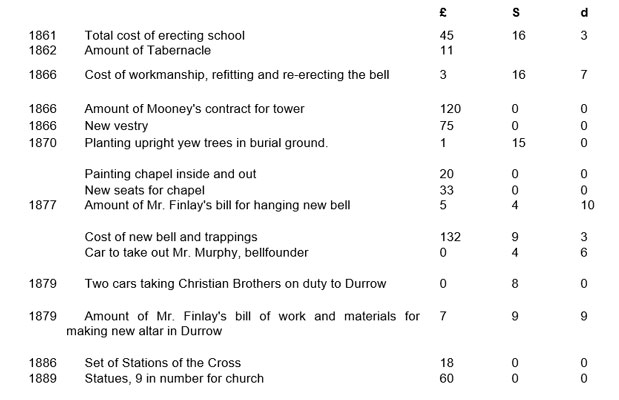
New Stations of the Cross were purchased in April 1950 and the statues purchased in 1889 have lately been cleaned and re-erected in the church. The Stations of the Cross now hanging in the church were donated by the Society of Jesus and originally hung in Rahan Jesuit Church – Tullabeg College. They were made in the 1940s for the Star of the Sea church in Sandymount, Dublin.
Considerable repair works were carried out on the church over the hundred years 1890 to 1990. The most significant, until recently, being that in 1984 under the direction of Edward Smith, architect and the Tullamore building firm of John Flanagan. At the time a prime objective was to cure a persistent proble of dampness.The stonework was cleaned the plaster removed and the stonework painted and sealed. The old windows were replaced in teak to a similar design. Some years earlier, in 1970, Rev. Laurence Bannon, had carried renovations to the sanctuary in Durrow church. It was at this time that large wooden crucifix was brought from Tullamore church to Durrow. The crucifix was, it is believed, made in Oberammagu.
The Cemetery
The cemetery was consecrated by Bishop Cantwell in September 1832. Until 1893 when Clonminch was opened it served the needs of the entire parish. The cemetery was extended in 1917 following a promise of Otway Toler’s of some four years earlier to provide additional land. This seems to have been part of a package whereby the agreement of the parish priest, Fr. Callary, was secured for the closing of the old abbey cemetery. The elaborate Calvary monument was erected at the expense of the Quinn family in 1930. The tombstones in this cemetery have not been recorded. Among those buried here are members of leading Tullamore families of the last century.


