


A description of the church in The Irish Builder (20 Oct. 1906) is worth reproducing.
A large and important church was dedicated on Sunday week by the Most Revd. Dr. Gaughran, Bishop of Meath, at Tullamore. The church, which has but recently been completed, was designed by the late Mr William Hague, and built under the supervision of Mr. T.F. McNamera, of Dublin. The building, which is Gothic, is about 200 feet from the ground, 172 feet is the length from outside east wall to the west door, the nave 36 feet wide, side aisles 18 feet wide each. The sanctuary has on each side two chapels, behind one of which is the sacristy, and near the other a well-lighted room reserved for the nuns who have easy access to their convent. The chancel arch rests on two columns and smaller pillars of Galway granite. Over the altars the groined roof is of fibrous plaster, while that of the centre is of pitch pine. The windows contain cathedral glass, and perfection appears to have been reached in the ventilation, heating, and lighting, the last being by means of electric installation. At the west end is the organ, an instrument the look of which is in harmony with the whole edifice, and was supplied by Telford, of Dublin. The High Alter is a magnificent proof of the sculptor’s art. It is of Sicilian marble with panels of Carara and shafts of Cork and Connemara marble, the artists being Messrs. Malone, also of Dublin. There are already also stained glass windows and the Stations, in oils. The stone materials were taken from the local quarries and, as far as possible, local tradesmen and labourers were employed throughout. . .
In 1930 the walls of the sanctuary were decorated in mosaics at a cost of over £2,500, by the firm of Oppenheimer of Manchester, who were responsible for other work in the diocese of Meath, including the cathedral at Mullingar. In 1970 the Tullamore church was sandblasted and pointed and the spire repaired. In 1972 the organ, considered to be one of the finest in the midland counties, was completely rebuilt under the supervision of Mr Kenneth Jones and at the instigation of the then parish priest, Monsignor
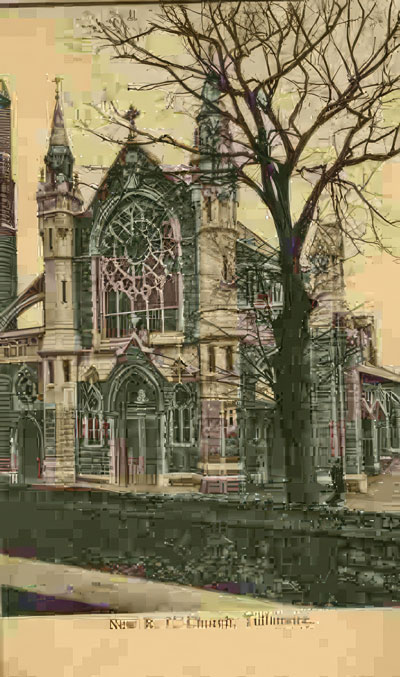
Denis Clarke. In 1977 the sanctuary of the church was reconstructed in accordance with modern day liturgical requirements as well as redecorated and rewired. Improvements were made to the grounds also. All this was to change in the early hours of the 31st of October 1983 when the Church of the Assumption was destroyed by fire. By morning all that remained was a burnt out shell.
Edward N Smith and Partners, architects, were selected by the then parish priest, Fr P Fallon, to design the new church. The architect’s brief was to re-build the church in such a way as retain or regain as much as possible of the character of the old church but in a modern idiom. This was next to impossible to achieve. He reused much of the old stonework especially on the Chapel Street side and went for a contemporary interior. What was lost of the Gothic exterior and interior was replaced in the self finished timber ceilings and laminated structural frames of the interior. Full restoration of the exterior was not possible in the 1980s. For many the most attractive feature of the new church was the warm and modern interior with its timber spans. John Flanagan & Sons Limited was appointed builders and work began in October 1984 and was completed for the opening of the present and third church on the Harbour Street site in August 1986. The new church had cost £2.6 million with the surplus after all collections and donations placed in a trust fund for the continuing upkeep of the church into the future.
The Offaly Historical and Archaeological Society has pleasure in presenting to the public a reproduction of a souvenir booklet of the early part of the last century depicting the old church now being celebrated. The work of the Society is to serve as a storehouse of community and family history and to make it available to a wide public so as to help people to appreciate what they have and where it came from. Our thanks to Fr Sean McGearty, for many years a curate in Tullamore, and now in Australia, who did so much to kindle interest in church records. Thanks also to Breda Hoey for a copy of the original booklet. To Brid Broderick for her input on the works of art in the present church and finally to the parish priest, Fr Sean Heaney, for his support. A more detailed treatment of the history of the church was published almost twenty years ago.*
* Michael Byrne, Tullamore Catholic Parish: a historical survey (Tullamore, 1987)
This article may only be reproduced, stored, or transmitted, in any form or by any means with prior permission of the Offaly Historical and Archaeological Society (C) Copyright 2006
The booklet is available in the
Offaly Historical and Archaeological Society
info@offalyhistory.com


